
The FIDIC Programme: What Sub-Clause 8.3 Actually Requires
Updated: 2 days ago
By Roman Bazelchuk | NEC Accredited Project Manager | APMG Project Planning and Control
Founder, NEC Planning Solutions Ltd
A FIDIC programme becomes the Programme, the term the 2017 contracts define, once the Engineer gives a Notice of No-objection to it under Sub-Clause 8.3, or lets the review period pass without giving Notice: 21 days for the initial programme and 14 for each revision. Silence is enough. There is no approval step.
FIDIC does not ask anyone to approve the programme. It asks the Engineer to review it, and gives the Engineer a period in which to say, by Notice, where it falls short. When the period ends without one, the Engineer is treated as having no objection, and the definition does the rest.
So a project can be running against a Programme in the defined sense without anybody having decided to create one. The Engineer read it, had reservations, meant to write, and did not. The document on the wall is now the reference point for the monthly progress reports, the next revision and any claim for time.
This guide sets out the FIDIC programme requirements in the 2017 Red, Yellow and Silver Books: what Sub-Clause 8.3 asks for, how the review and the deemed Notice of No-objection work, when and how the programme is revised, and where the mechanism differs from NEC acceptance. The wider comparison is in how FIDIC and NEC differ for contractors, and the claim the programme supports is in the FIDIC extension of time guide.
References are to the 2017 Red Book, reprinted with amendments in 2022. Sub-Clause 8.3, often called FIDIC clause 8.3, works the same way in the Yellow Book, with the Employer's Requirements where the Red Book says the Specification. The Silver Book has no Engineer, so the Employer, usually through its Employer's Representative, carries out the review on the same periods. The 1999 rules are set out near the end.
FIDIC programme requirements under Sub-Clause 8.3
The sequence starts at Sub-Clause 8.1. The Engineer gives the Contractor a Notice of the Commencement Date at least 14 days before it, and the Contractor has 28 days from receiving that Notice to submit the initial programme. It is prepared in the programming software the Specification names or, if none is named, software acceptable to the Engineer.
The 2017 edition is far more prescriptive than 1999 about what the FIDIC programme has to show. Every programme, initial or revised, carries the items in Table 1, except that items (f) and (j), and the supporting report's account of significant changes under (k), apply only to revisions.
Item | What the programme shows |
(a) | The Commencement Date and the Time for Completion, for the Works and for each Section |
(b) | When the Contractor is to have access to each part of the Site, as the Contract Data states or, failing that, as the Contractor requires |
(c) | The intended order of the work, stage by stage, from design and the Contractor's Documents through procurement, manufacture and delivery to construction, installation and testing, nominated Subcontractors included |
(d) | The review periods for the Contractor's submissions |
(e) | When the inspections and tests the Contract requires take place, and in what order |
(f) | In a revision: when any remedial work will be carried out |
(g) | Every activity, to the level of detail the Specification sets, linked by logic, with early and late dates, float and the critical path |
(h) | Local rest days and holiday periods |
(i) | The key dates for delivery of Plant and Materials |
(j) | In a revision: actual progress on each activity, any delay to it and its effect on other activities |
(k) | A supporting report: the main stages, the methods, the personnel and Equipment each main stage needs, in a revision the significant changes from the previous programme, and how the Contractor proposes to deal with the effects of delay |
Table 1: what each programme carries under Sub-Clause 8.3 of the 2017 Red Book, paraphrased. The Particular Conditions can change it, and the Specification sets the software and the level of detail.
Item (g) does the most work for a planner. The 1999 Red Book asked for four things: the order and timing of the work, the same stages for nominated Subcontractors, the inspections and tests, and a supporting report on methods and resources. It asked for no logic, float or critical path. The 2017 list adds those, along with the key dates, the access dates and the two items that keep a revision honest: actual progress under (j), and the supporting report's account of what changed.
Much of the real obligation sits in the Specification, or the Employer's Requirements. It names the software and sets the level of detail under (g), and it can add coding, formats or an update cycle of its own. Read it alongside Sub-Clause 8.3 before deciding what the job requires.
NEC Planning Solutions reviews FIDIC programmes against Sub-Clause 8.3 and the Specification before they go to the Engineer, and builds the revisions that keep the Programme current. The first look at a programme is at no charge, and an independent review starts from £1,250 plus VAT. On a £20M FIDIC carbon capture plant in Northwich it built the logic-linked baseline and kept the change register that quantified the programme impact of design changes. See programme review and recovery and the carbon capture plant case study.
The Programme becomes the Programme by silence
The Engineer reviews each programme. Review, in the 2017 definitions, means examining a submission to assess whether, and how far, it complies with the Contract. Where it falls short, the Engineer may give a Notice stating how far it fails to comply with the Contract, has stopped reflecting actual progress or otherwise conflicts with the Contractor's obligations.
The Engineer has 21 days from receiving the initial programme, and 14 days from receiving a revised one. If no Notice arrives within that period, the Engineer is treated as having given a Notice of No-objection, and that programme is then the Programme. The 2017 definition is exactly that: the detailed time programme the Contractor submitted, once a Notice of No-objection has been given to it or is treated as given.
So the Engineer approves nothing. The Engineer either gives a Notice of No-objection or stays silent through the period, and either route produces the same defined document. A Notice within the period, stating where the programme falls short, is the only way to stop it.
Two consequences follow in the same Sub-Clause. The Contractor carries out the work in line with the Programme, subject to its other obligations under the Contract. And the Employer's Personnel may rely on the Programme in planning their own work, so a Programme that has stopped matching the work misleads both sides.
Silence settles the status of that programme, not its quality. The Engineer can still give Notice at any time that a programme fails to comply, has stopped reflecting actual progress or conflicts with the Contractor's obligations, and the Contractor then has 14 days to submit a revised one. In the 2022 reprint that power reaches any programme, not only the Programme. A thin programme that drew no Notice is the Programme, but it is not safe from a later Notice.
How the FIDIC programme differs from NEC acceptance
The two mechanisms look alike and work differently. Under NEC4, clause 31.3 gives the Project Manager two weeks to accept a programme or give reasons for not accepting it. If the reply is late, the Contractor may notify the failure, and a further week of silence is treated as acceptance. Acceptance is something the Contractor chases.
Under FIDIC nobody chases. The Engineer's silence is the answer, automatically, with no notification from the Contractor and no further period. The burden sits with the reviewer, and the default outcome favours the party that submitted.
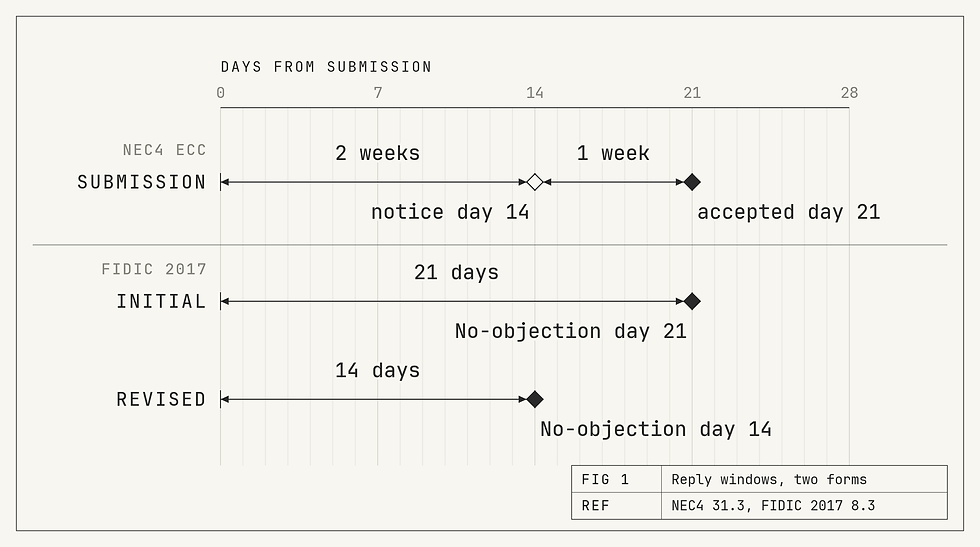
The revision duties differ too. NEC4 sets an interval in the Contract Data and requires a revised programme at least that often, whether or not anyone asks, which is the discipline behind clause 32. Sub-Clause 8.3 sets no interval. It triggers a revision on a condition rather than a clock, as the next section sets out, so a team used to the NEC rhythm has to watch for the condition instead of the calendar.
Revised programmes under Sub-Clause 8.3
A FIDIC programme is not a one-off submission. Sub-Clause 8.3 keeps it current through revisions, and each revision passes through the same review before it becomes the Programme.
When a revision is due
Revisions come from four directions. The Contractor submits one whenever the current programme stops reflecting actual progress or conflicts with its obligations, with no calendar to prompt it. It submits one within 14 days after an Engineer's Notice that a programme falls short. And it submits one when the Engineer instructs it under Sub-Clause 8.7: where progress is too slow to finish on time, or is or will be behind the Programme, for a cause not listed in Sub-Clause 8.5, the revision describes the revised methods the Contractor will use to expedite progress, and the Contractor adopts them at its own risk and cost.
The fourth runs alongside them. When the Engineer instructs a Variation, the Contractor's particulars, due within 28 days or another period the Contractor proposes and the Engineer agrees, include a programme for the varied work and any changes it proposes to the Programme and to the Time for Completion (13.3.1).
What a revision has to show
A revised programme shows the work as it stands, delays included. It carries everything in Table 1 and two items an initial programme does not: when any remedial work will be done, under (f), and, under (j), the actual progress of each activity, any delay to it and the effect on other activities. Its supporting report identifies the significant changes from the previous programme and sets out how the Contractor proposes to deal with the effects of delay. Those two report items say what moved and what the Contractor will do about it, which is what a reviewer needs from a revision.
Figure 2 marks those items on an extract of a revised programme.

The 14-day review and the Programme in force
Each revision goes through the review again, with 14 days for the Engineer. On the definition, the previous Programme remains the Programme until a revision takes its place, by a Notice of No-objection or by the Engineer's silence. That matters on a claim for time. The SCL Delay and Disruption Protocol has a time impact analysis work from the most recent updated programme, brought up to date to just before the event, so the record of which revision was current, and which had become the Programme, on which date is evidence in its own right.
PLANNER'S TAKEAWAY Keep a programme register: each revision's number and data date, the day the Engineer received it, the day its review period ends, and the outcome, either a Notice with the shortfalls it states or a deemed Notice of No-objection. On any date it shows which document is the Programme. |
What the Programme is not
It is not a Contract document. The Programme is not among the documents forming the Contract under Sub-Clause 1.5, and the Contractor follows it only subject to its other obligations. Nothing in Sub-Clause 8.3 changes what the Works are. The Engineer has no authority to relieve the Contractor of any obligation (3.2), so a Notice of No-objection, given or deemed, does not do so either.
Nor is it a Notice, or a claim. Sub-Clause 8.3 says that nothing in a programme or its supporting report counts as a Notice, and Sub-Clause 4.20 says the same of the monthly progress report. An extension of time comes through Sub-Clause 8.5 and, except for a Variation, a claim under Sub-Clause 20.2 that starts with a Notice of Claim within 28 days. A revision that shows a delay is evidence of the delay. It does not claim the extension.
It is evidence, though, and evidence can help a late claim. A late Notice of Claim is treated as valid unless the Engineer gives Notice within 14 days that it was late (20.2.2), though the Employer can still dispute it. Where the Engineer does give that Notice, the agreement or determination of the claim can still find the lateness justified (20.2.5), weighing among other things what the Employer already knew of the event. A revised Programme that showed the event as it happened is evidence of exactly that.
The revisions, the gaps between them and the correspondence around them also form the record a dispute board or tribunal is likely to read to understand how the job was meant to run and what happened to it. That is the same reason a programme that quietly loses its integrity costs far more than the hours it would have taken to keep it honest.
Advance warning and the rest of Clause 8
The 2017 edition gave advance warning its own Sub-Clause, 8.4, and made it mutual. Each Party advises the other and the Engineer, and the Engineer advises the Parties, of events or circumstances, known or probable, that could hamper the Contractor's Personnel in their work, impair how the completed Works perform, add to the Contract Price, or delay the Works or a Section. In the 1999 books the duty sat in Sub-Clause 8.3 and fell on the Contractor alone. Neither edition attaches an express sanction to a missed warning, but a warning on file can matter later, when what the Employer knew is in question.
Extensions of time moved from Sub-Clause 8.4 in 1999 to 8.5 in 2017, and concurrent delay is now assessed under the rules the Special Provisions set out or, if they set out none, as is appropriate in all the relevant circumstances. Both belong to the claim rather than the programme, and the FIDIC extension of time guide covers them, from the five grounds to the 84-day fully detailed Claim.
If your contract is on the 1999 books
Contracts let on the 1999 Red and Yellow Books are still running, and their Sub-Clause 8.3 is shorter. The programme is due within 28 days of the commencement notice, and a revised one whenever the last one no longer matches actual progress or the Contractor's obligations. The Red Book asks for four things: the order and timing of the work, the same stages for nominated Subcontractors, the inspections and tests, and a supporting report on methods and resources.
The review is different in kind. If the Engineer gives no notice of non-compliance within 21 days after a programme arrives, the Contractor goes ahead on it, and the Employer's Personnel may rely on it. There is no deemed Notice of No-objection and no defined Programme, and when the Engineer gives notice that a programme falls short, the 1999 text sets no period for the revision.
The view from the desk
In my view the deemed Notice of No-objection is the most underused provision in FIDIC programming. A programme that drew no Notice within its period is the Programme, whatever is said about it months later, until a later revision takes its place. It is easy for both sides to lose track of that, and the side that remembers it holds the stronger position in the next argument about time.
My position is that each review period should be diarised from the day the Engineer receives the programme, and the outcome recorded either way. If a Notice arrives, the Contractor has 14 days and a stated list of shortfalls to answer. If it does not, a short letter recording that no Notice was given within the period, and that the programme is treated as having received a Notice of No-objection, costs ten minutes and turns silence into a document.
And I would resist reading no-objection as approval. It means the reviewer did not object, which says something about the reviewer rather than the programme. A weak programme that nobody challenged is still a weak programme, and it will be read as evidence of how the job was run long after the question of whether it complied has stopped mattering.
Summary
Under the 2017 books, a FIDIC programme is due within 28 days of the commencement Notice, carries the eleven items Sub-Clause 8.3 lists, from the access dates to the critical path, and becomes the Programme when the Engineer gives a Notice of No-objection or lets 21 days pass without giving a Notice, 14 for a revision. The Contractor follows it, subject to its other obligations, and the Employer's Personnel may rely on it.
It is revised whenever it stops reflecting actual progress or the Contractor's obligations, within 14 days of an Engineer's Notice that it falls short, and when the Engineer instructs a revision under Sub-Clause 8.7. It is evidence, not entitlement: an extension of time still needs a claim under Sub-Clause 20.2, unless the delay comes from a Variation. Read the Specification alongside Sub-Clause 8.3, diarise every review period, and keep a register of which revision is the Programme.
Download the FIDIC programme checklist
A two-page check for each submission: what to read in the Specification first, the eleven items Sub-Clause 8.3 asks for, the supporting report, the review periods and the deemed Notice of No-objection, and the four routes to a revision. Direct download, no sign-up.

FIDIC programme: frequently asked questions
Does the Engineer approve the programme under FIDIC?
No. Under Sub-Clause 8.3 of the 2017 books the Engineer reviews each programme and may give a Notice stating how far it fails to comply with the Contract. There is no approval step. If no Notice is given within the review period, the Engineer is treated as having given a Notice of No-objection, and the programme becomes the Programme.
How long does the Engineer have to review a FIDIC programme?
The Engineer has 21 days after receiving the initial programme and 14 days after receiving a revised one. If no Notice is given in that time, a Notice of No-objection is treated as given. The Contractor does not have to notify the failure or wait any longer, which is where FIDIC differs from NEC4, where the Contractor notifies and waits a further week.
What must a FIDIC programme contain?
Sub-Clause 8.3 of the 2017 books lists eleven items: the Commencement Date and Time for Completion, the access dates, the order of the work, the review periods, the inspections and tests, remedial work in a revision, every activity linked by logic with float and the critical path, rest days, key delivery dates, actual progress in a revision, and a supporting report.
When must a FIDIC programme be revised?
Whenever it stops reflecting actual progress or conflicts with the Contractor's obligations. Sub-Clause 8.3 sets no fixed interval, though the Specification may. A revision is also due within 14 days after an Engineer's Notice that a programme falls short, and when the Engineer instructs one under Sub-Clause 8.7 because progress is too slow or has fallen behind. Each revision then has its own 14-day review.
Is the FIDIC Programme a contract document?
No. It is not among the documents forming the Contract under Sub-Clause 1.5, and a Notice of No-objection does not relieve the Contractor of any obligation. The Contractor follows the Programme, subject to its other obligations, and the Employer's Personnel may rely on it when planning their own work. It is also the record against which progress, revisions and claims for time are read.
Does a revised programme count as a Notice of Claim?
No. Sub-Clause 8.3 says nothing in a programme or its supporting report counts as a Notice, and Sub-Clause 4.20 says the same of progress reports. Except for a Variation, an extension of time needs a Notice of Claim under Sub-Clause 20.2 within 28 days. A revision that showed the event can still help if that Notice is late, under Sub-Clause 20.2.5.
What changed in Sub-Clause 8.3 between FIDIC 1999 and 2017?
The 1999 Red Book asked for four items and gave the Engineer 21 days from receiving any programme to give notice of non-compliance. Without one the Contractor proceeded on it, but there was no deemed Notice of No-objection or defined Programme. The 2017 edition lists eleven items, including the critical path, cuts the review of a revision to 14 days and sets 14 days to revise after a Notice.
About the author
Roman Bazelchuk is the Founder of NEC Planning Solutions Ltd, a UK project planning and controls consultancy supporting contractors with NEC programme compliance, compensation event assessments and live project controls. He is an NEC Accredited Project Manager and holds the APMG Project Planning and Control qualification, with a BEng in Mechanical Engineering and postgraduate training in Planning and Control.
NEC Planning Solutions provides contract-aware planning support through a QA-governed delivery model, helping project teams keep programmes accepted, current and commercially useful from tender through to live delivery.
Running FIDIC work and unsure where your programme stands?
NEC Planning Solutions reviews FIDIC programmes against the requirements that actually apply, builds the revisions and keeps the review periods and the revision record straight, so the position is known rather than assumed. That was the job on the Northwich carbon capture plant, a FIDIC contract where the baseline had to stay defensible through ongoing scope and design change.


