
NEC vs FIDIC: Why Contractors Keep Making the Same Mistakes
Updated: Sep 13
By Roman Bazelchuk | NEC Accredited Project Manager | APMG Project Planning and Control
Founder, NEC Planning Solutions Ltd
A UK Tier 2 contractor with a strong NEC track record won its first major FIDIC contract in early 2025. The project was an industrial facility extension in the Middle East. The bid team had treated FIDIC as a procedural variation on NEC: same essential mechanics, different terminology, different notice periods, manageable with a competent commercial team and a careful read of the FIDIC General Conditions. Eighteen months later, the project was in dispute. The contractor's claims had been rejected for inadequate substantiation. The Engineer had refused to certify several variations. The contractor's legal team was reconstructing the project record from emails and site diaries. The internal review identified the cause as "weak claims preparation." The deeper cause was different. The contractor had treated FIDIC as if it were NEC with different forms.
A different pattern, in the opposite direction. A UK contractor with extensive Middle East and Asia FIDIC experience won an NEC4 contract on a UK water sector AMP8 framework. The bid team had treated NEC as a procedural variation on FIDIC: same essential mechanics, different terminology, more frequent paperwork, manageable with a competent commercial team. Six months into delivery, the accepted programme had not been formally accepted, compensation event quotations were being routinely rejected, and the project manager had started invoking clause 64 to make their own assessments. The contractor's commercial position was deteriorating in ways the team had not seen before. The internal review identified the cause as "poor NEC administration." The deeper cause was different. The contractor had treated NEC as if it were FIDIC with different forms.
Both patterns are repeating across UK and international construction in 2025 and 2026, and they have the same underlying cause. The way the industry typically discusses NEC versus FIDIC is wrong, and the wrongness produces predictable contractor failures in both directions.
The standard comparison frames the two contracts as alternatives that a contractor might prefer one or the other of, based on which feels more familiar or which has more favourable provisions in some general sense. The framing assumes the contracts are different versions of the same underlying mechanism. They are not. NEC and FIDIC are not better or worse than each other and they are not procedural variations on a shared template. They are contracts that reward fundamentally different organisational capabilities in the contractor that holds them, and the contractor who switches between them without recognising the capability switch produces the failures described above.
This article explains the capability reframe in detail. It covers what each contract is genuinely testing for, why contractors strong on one tend to fail on the other, what the practical capabilities look like in the contractor's organisation, and how the strongest contractors operating across both contracts have learned to switch capability sets project by project. It is written for delivery directors, commercial leads, and bid functions in contractors who work across both contract regimes or who are moving into the other one for the first time.
What NEC is actually testing in a contractor
The standard description of NEC focuses on what NEC requires: an accepted programme under clause 31, regular revisions under clause 32, compensation event notifications within eight weeks under clause 61.3, quotations within three weeks under clause 62. These are the surface mechanics. The description is accurate but misses what the mechanics are actually testing for.
NEC is testing the contractor's capability to operate a continuous programme dialogue with the project manager. The contract is built on the assumption that the programme is a live document that the contractor maintains, the project manager reviews, and both parties use as the shared reference frame for every decision about time and money. Every NEC mechanism (clause 31 acceptance, clause 32 revisions, clause 61 early warning, clause 62 quotations, clause 63 assessment, clause 64 project manager assessment) is designed to keep that dialogue current and to penalise contractors who let it lapse.
The capability being tested is therefore not technical sophistication in programme analysis (although that helps). The capability being tested is operational discipline in maintaining the programme as a live reference and engaging the project manager in continuous dialogue about it. A contractor with this capability runs NEC well because they are doing what the contract was designed to reward. A contractor without it struggles because every mechanism the contract uses depends on the dialogue being live.
The article on NEC clause 31 programme acceptance covers the programme acceptance dialogue. The article on NEC clause 32 programme revision covers the revision discipline that keeps the programme current. The article on the NEC4 compensation event time bar covers the procedural discipline that protects entitlement. Each of these depends on the underlying capability: continuous programme dialogue maintained as an organisational habit.
The contractor who treats NEC as a contract that requires "more paperwork" is misreading the design. NEC does not require more paperwork than FIDIC. It requires more continuous dialogue. The paperwork volume is a consequence of the dialogue, not the purpose of it.
What FIDIC is actually testing in a contractor
FIDIC is similarly often described in terms of its mechanics: the Engineer's role under the Red Book, the 28-day notice requirements under clauses 8.4 and 20.1 (in the older editions) or the updated provisions in the 2017 Second Edition, the formal claim submission requirements, the detailed substantiation expectations. These are again the surface mechanics. The mechanics are accurate but the underlying test is different from what most contractors recognise.
FIDIC is testing the contractor's capability to construct evidence-led claims from a complete contemporaneous record. The contract is built on the assumption that the project will be administered through formal communication channels (notices, instructions, certifications, claims), that the Engineer will make determinations based on the evidence each party submits, and that disputes about time and money will be resolved through written submissions backed by documentation. Every FIDIC mechanism (the Engineer's role, the notice procedures, the claim particulars, the dispute resolution chain) is designed to produce decisions based on evidence quality.
The capability being tested is therefore not operational dialogue (although communication still matters). The capability being tested is organisational discipline in producing, maintaining, and deploying complete contemporaneous records that support evidence-led claims. A contractor with this capability runs FIDIC well because they have the records to substantiate every position they take. A contractor without it struggles because FIDIC's decision-making mechanism depends on evidence and reduces entitlement in its absence.
The FIDIC requirement for "contemporaneous records" appears in multiple clauses across the standard forms and is the single most important contractor obligation in the contract. Site diaries, daily resource records, photographs, RFIs, instructions, meeting minutes, programme updates, progress reports, quality records, weather records, and correspondence all form the evidential foundation that FIDIC claims are built on. The contractor whose record-keeping is reactive (assembled when a claim becomes necessary) produces weaker claims than the contractor whose record-keeping is systematic (maintained as a daily operational discipline regardless of whether a claim is anticipated).
On EU-funded FIDIC work the bar is higher again, because the records have to satisfy a funding audit as well as the Engineer. FIDIC programme and EOT evidence on EU-funded projects sets out what an acceptable programme and a defensible claim contain.
The contractor who treats FIDIC as a contract that allows "less day-to-day administration" is misreading the design. FIDIC does not require less administration than NEC. It requires different administration. The day-to-day burden of FIDIC is distributed across the project rather than concentrated at the formal submission points, and it manifests as records discipline rather than as programme dialogue.
The reframe: two different capabilities, not two versions of the same mechanism
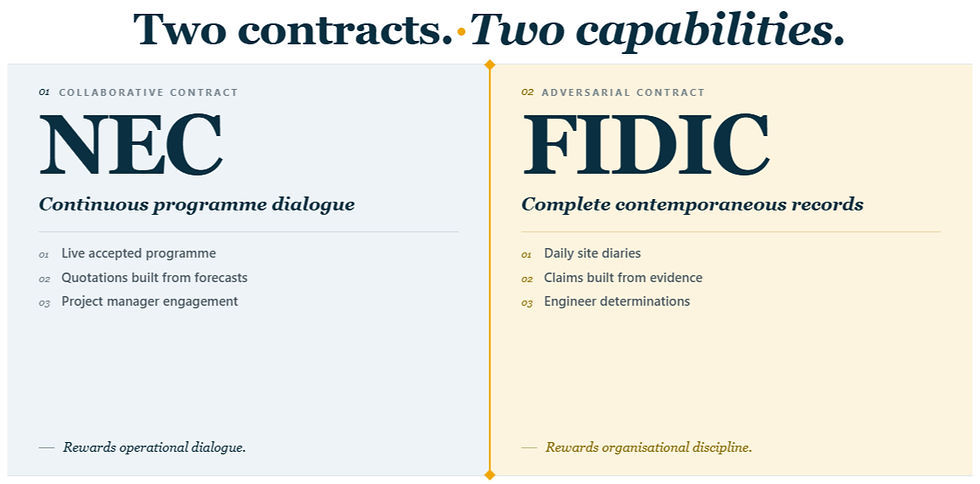
The capability reframe is the analytical key that unlocks how to operate across both contracts. Once the two capabilities are named distinctly (continuous programme dialogue for NEC, complete contemporaneous records for FIDIC), the predictable failure modes become obvious.
A contractor strong on NEC tends to fail on FIDIC because they have built their organisation around the programme dialogue capability. The planning function is active, the project manager relationship is collaborative, the programme is updated continuously, the compensation event log is current. When the same contractor wins a FIDIC contract, they assume the same disciplines will translate. They underinvest in records because their NEC experience taught them that the programme dialogue substitutes for documentation. Twelve months in, when a claim needs to be made, the records are not there to support it. The Engineer makes a determination based on the limited evidence available, which is unfavourable to the contractor. The contractor concludes that FIDIC is harder than NEC, when the actual issue is that the contractor failed to build the FIDIC capability.
A contractor strong on FIDIC tends to fail on NEC in the mirror pattern. They have built their organisation around the records capability. Site diaries are thorough, document control is well-developed, contemporaneous evidence is captured systematically. When the same contractor wins an NEC contract, they assume the same disciplines will translate. They underinvest in programme dialogue because their FIDIC experience taught them that records can substitute for ongoing engagement. Six months in, the accepted programme is months out of date, compensation events are accumulating without quotations, and the project manager is invoking clause 64. The contractor concludes that NEC is harder than FIDIC, when the actual issue is that the contractor failed to build the NEC capability.
This pattern is so consistent that experienced commercial directors learn to spot it within the first project. The "wrong capability deployment" is the most reliable predictor of contractor difficulty when switching between the two regimes. It is also the most preventable, because the capability switch is recognisable and the disciplines required for each contract are well documented.
The strongest contractors operating across both regimes have learned to treat each project as a capability deployment decision rather than as an extension of their default operating model. They identify the contract form early. They confirm which capability set the project requires. They deploy the people, processes, and tools that match the capability requirement. They run the project on the capability the contract is testing for rather than on the capability the contractor finds most natural.
NEC vs FIDIC at the operational level: where the capabilities show up
The two capabilities express themselves in distinct operational behaviours that cascade through every aspect of project delivery. Understanding where each capability shows up makes it easier to recognise capability deployment failures while they are still correctable.
At programme submission. Under NEC, the programme submission triggers the formal acceptance dialogue under clause 31. The submission is the start of a conversation, not the end of one. The contractor expects review comments, addresses them, resubmits, and treats the cycle as productive operational work. The capability being deployed is dialogue management. Under FIDIC, the programme submission is more transactional. The contractor submits, the Engineer approves or rejects, the approved programme becomes the baseline. The capability being deployed is producing a programme that survives initial scrutiny because subsequent dialogue is more limited.
At programme revision. Under NEC, clause 32 revisions are a regular operational rhythm. The contractor revises the programme at the contract data interval (typically four-weekly), incorporates progress, reflects accepted changes, and resubmits. The revision discipline is part of how the project is run. Under FIDIC, programme updates happen but they are less central to the contractual relationship. The baseline programme remains the dominant reference. The contractor may produce updated versions but the operational and contractual weight sits on the baseline plus the formal change instructions that modify it.
At change notification. Under NEC, the contractor notifies compensation events within eight weeks of becoming aware under clause 61.3. The notification is formal and triggers a defined process. Under FIDIC, the contractor gives notice of claim within the notice period (28 days under most editions) and then submits particulars within a longer period. The notice mechanism is structurally similar but the substantive expectations differ: NEC expects the contractor to engage prospectively (a quotation built from a forecast position), FIDIC expects the contractor to assemble the substantive claim from the records.
At change assessment. Under NEC, the contractor's quotation under clause 62 is built from a forecast position assessed against the accepted programme current at the dividing date. The assessment is prospective and depends on the programme being current. Under FIDIC, the claim is built from contemporaneous records of what actually happened, with the time impact analysis typically performed retrospectively against the baseline programme. The assessment is evidence-led and depends on the records being complete.
At dispute resolution. Under NEC, disputes typically reach senior representatives under W1 before formal adjudication and tend to be resolved through commercial dialogue informed by the programme position. Under FIDIC, disputes flow through the Engineer's determination, the Dispute Adjudication Board (DAB) or Dispute Avoidance and Adjudication Board (DAAB), and ultimately arbitration if necessary. The FIDIC route is more formal, longer, and more evidentially demanding.
In each of these operational moments, the capability being deployed is different. The contractor who deploys NEC capability on a FIDIC project produces dialogue where evidence is expected. The contractor who deploys FIDIC capability on an NEC project produces records where dialogue is expected. Both fail in their own way, and both failures are preventable.
What good practice looks like when switching contracts
The strongest contractors operating across both regimes have learned to treat the capability switch as a deliberate operational discipline rather than as something that will happen naturally. Several specific practices distinguish them from contractors who continue to deploy their default capability regardless of contract form.
Capability assessment at bid stage. Before bidding into a project, the contractor assesses which capability the contract form will require and confirms internally that the team being deployed has that capability. An NEC bid going to a team accustomed to FIDIC is flagged for capability strengthening (additional planning resource, programme dialogue training, NEC-specific quotation templates). A FIDIC bid going to a team accustomed to NEC is flagged for the opposite (additional records infrastructure, claims template development, document control review).
Project mobilisation aligned to capability. During mobilisation, the controls system, the document management system, the meeting cadence, and the reporting structure are aligned to the capability the contract requires. NEC mobilisation emphasises the programme dialogue infrastructure (accepted programme, revision rhythm, compensation event clock, early warning register). FIDIC mobilisation emphasises the records infrastructure (document control system, site diary discipline, photographic record protocol, contemporaneous evidence capture).
Different leadership profiles. The senior commercial leader on an NEC project benefits from being a strong dialogue manager, comfortable with continuous engagement and able to use the contract's mechanisms as conversation rather than confrontation. The senior commercial leader on a FIDIC project benefits from being a strong claims strategist, comfortable with formal procedures and able to assemble evidence-led submissions over extended periods. The skill profiles are different. The strongest contracting organisations match the leadership to the capability requirement rather than assuming any senior commercial leader can run any contract.
Different reporting structures. NEC reporting emphasises forward-looking forecast information (programme position, compensation event forecasts, key date achievement probability). FIDIC reporting emphasises backward-looking evidence summaries (notices issued, claims pending, determinations awaited, records captured). The reporting structures produce different information and support different decision-making approaches.
Different relationships with external support. Contractors who use specialist external support adapt the support to the capability being deployed. NEC support concentrates on programme dialogue, acceptance, and compensation event administration. FIDIC support concentrates on claims preparation, time impact analysis, and evidence assembly. The skill sets in external support are different and the contractor benefits from matching the support to the requirement.
For contractors who are recognising the capability mismatch on a current project and need to correct it, specialist support can rebuild the capability infrastructure within the existing project rather than waiting for the next mobilisation. The article on specialist NEC programme support covers the discipline that can be deployed mid-project to recover NEC capability that was not built at mobilisation.
The honest answer to "which contract is better for contractors"
This is the question contractors ask most often when comparing NEC and FIDIC, and the honest answer is that the question is wrong.
NEC is better for contractors who have built or are willing to build the continuous programme dialogue capability. The contract rewards that capability with timely change recovery, predictable commercial outcomes, and collaborative project relationships. The contractor who does not have the capability finds NEC difficult, not because the contract is bad but because they are running a contract designed for capabilities they have not invested in.
FIDIC is better for contractors who have built or are willing to build the complete records capability. The contract rewards that capability with successful claims, defensible positions in disputes, and the ability to operate across multiple jurisdictions with comparable contractual frameworks. The contractor who does not have the capability finds FIDIC difficult, not because the contract is bad but because they are running a contract designed for capabilities they have not invested in.
For most UK contractors who operate primarily under NEC, NEC is the right primary contract because the UK market has standardised around it and the supporting infrastructure (project managers, planning consultancies, training providers, professional bodies) is built around it. For contractors who operate primarily internationally, FIDIC is the right primary contract for the same reason: the international market uses it and the supporting infrastructure (engineers, claims consultants, arbitrators, legal expertise) is built around it.
For contractors who operate across both, the right answer is to build both capabilities and deploy them deliberately. This is the operational discipline that the strongest international contractors have developed over decades, and it is what separates contractors who can move comfortably between UK and international work from contractors who can only operate well in one regime.
NEC vs FIDIC: the practical summary for contractors
The standard NEC vs FIDIC comparison treats the two contracts as alternatives with different procedural mechanics, different terminology, different notice periods, different claims procedures. The comparison is accurate at the surface but misses the substantive point.
NEC and FIDIC are not procedural variations on a shared template. They are contracts that reward fundamentally different organisational capabilities. NEC rewards continuous programme dialogue maintained as an operational habit. FIDIC rewards thorough contemporaneous records maintained as an organisational discipline. The contractor who operates either contract well has built the capability that the contract is testing for.
The contractor who switches between the two contracts without recognising the capability switch produces predictable failures in both directions. Strong NEC contractors fail on FIDIC because they under-invest in records and assume the programme dialogue will substitute. Strong FIDIC contractors fail on NEC because they under-invest in dialogue and assume the records will substitute. Both failures are preventable and both are the most common pattern observed in contractors moving across the two regimes.
The strongest contractors operating across both regimes have learned to treat each project as a capability deployment decision. They identify the contract form early, confirm which capability set the project requires, deploy the people and processes that match the requirement, and run the project on the capability the contract is testing for rather than on the capability the contractor finds most natural.
For contractors who recognise the pattern but have not yet built the discipline, the practical investments are recognisable: capability assessment at bid stage, capability-aligned mobilisation, different leadership profiles for different contracts, different reporting structures, different external support relationships. None is technically demanding. All require organisational commitment to the recognition that the two contracts are testing different things and that contractor success requires matching the capability deployment to the test.
The question "which contract is better" is therefore the wrong question. The right question is "which capability am I building, and which contract is testing for that capability." The contractor who answers the second question accurately makes deliberate decisions about which contracts to bid for, which capability investments to make, and how to deploy resources across a portfolio of projects in both regimes. The contractor who keeps asking the first question continues to produce the same predictable failures in both directions.
FAQ
Is NEC or FIDIC better for contractors?
Neither is better in any absolute sense. NEC rewards contractors who have built continuous programme dialogue capability. FIDIC rewards contractors who have built thorough records capability. The right contract for a specific contractor depends on which capability the contractor has invested in. For most UK contractors, NEC is the primary contract because the UK market has standardised around it. For most international contractors, FIDIC is the primary contract for the same reason. Contractors operating across both regimes need to build both capabilities.
What is the biggest difference between NEC and FIDIC for programme management?
Under NEC, the programme is a live document that the contractor maintains in continuous dialogue with the project manager. Acceptance under clause 31 is the start of an ongoing conversation, with revisions under clause 32 at the contract data interval. Under FIDIC, the programme is more transactional: the contractor submits, the Engineer approves, the approved programme becomes the baseline reference. Updates happen but the operational and contractual weight sits on the baseline plus formal change instructions. The article on NEC clause 31 programme acceptance covers the NEC programme acceptance dialogue in detail.
How do NEC compensation events differ from FIDIC claims?
NEC compensation events are forecast-based and assessed prospectively against the accepted programme current at the dividing date. The contractor builds a quotation that projects forward what the impact will be. FIDIC claims are evidence-based and assessed retrospectively against the baseline programme using contemporaneous records of what actually happened. The substantive expectations are different: NEC expects forecast modelling, FIDIC expects evidence assembly. The contractor's capability requirements are correspondingly different.
Why do contractors who are strong on NEC tend to struggle when they move to FIDIC?
Because they have built their organisation around the continuous programme dialogue capability that NEC rewards, and they under-invest in the contemporaneous records capability that FIDIC requires. The dialogue habits that produce NEC success do not substitute for the records that FIDIC needs. The contractor finds that claims fail for inadequate substantiation, not because the contractor lacks technical capability but because the organisation did not build the FIDIC capability in parallel.
What capability should contractors prioritise if they work across both contract regimes?
Both, deployed deliberately. The strongest contractors operating across both regimes treat each project as a capability deployment decision rather than as an extension of their default operating model. They identify the contract form early, confirm which capability set the project requires, and match the people, processes, and external support to the capability requirement. This is the operational discipline that separates contractors who can move comfortably between UK and international work from contractors who can only operate well in one regime.
About the author
Roman Bazelchuk is the Founder of NEC Planning Solutions Ltd, a UK project planning and controls consultancy supporting contractors with NEC programme compliance, compensation event assessments and live project controls. He is an NEC Accredited Project Manager and holds the APMG Project Planning and Control qualification, with a BEng in Mechanical Engineering and postgraduate training in Planning and Control.
NEC Planning Solutions provides contract-aware planning support through a QA-governed delivery model, helping project teams keep programmes accepted, current and commercially useful from tender through to live delivery.
Recognising the capability mismatch on a current NEC project and need to correct it?
If the accepted programme has drifted from the live job, if compensation event quotations are being rejected because the cause-and-effect chain cannot be demonstrated, or if the team is treating NEC as if it were FIDIC and producing records where dialogue is expected, specialist NEC programme support rebuilds the dialogue capability and brings the contract administration back into line with what NEC is actually testing for.


