
Programme Recovery: When Working Harder Stops Working
Updated: 5 days ago
By Roman Bazelchuk | NEC Accredited Project Manager | APMG Project Planning and Control
Founder, NEC Planning Solutions Ltd
Programme recovery is not acceleration. Acceleration buys time with money against a programme you still believe. Recovery is what you do when the programme has stopped describing the job, and no amount of effort measured against it will close the gap, because the gap is not where the programme says it is.
The situation is familiar enough to be a genre. Progress has been reported at somewhere near plan for months. Then a date moves that should not have moved, or a subcontractor asks a question nobody can answer from the programme, and it becomes clear the position is worse than the reporting has been saying. The client asks for a recovery plan. Somebody compresses the bars until the end date fits and issues it.
That document is not a recovery plan. It is the same programme with less air in it, and everyone in the room knows it within a fortnight. Recovery starts somewhere less comfortable.
What programme recovery actually is
It is the exercise of establishing where the project genuinely is, rebuilding a programme that describes that position honestly, and then working out what can still be done about the end date. In that order. The order is the whole thing, and it is the part that gets reversed under pressure.
It is distinct from acceleration, which is a contractual question about who pays for working faster and under which mechanism. That question matters and it is set out in the guide to NEC acceleration and mitigation. But it is the second question. Accelerating against a programme that does not reflect reality buys you compression in the wrong place, at cost, and the date moves anyway.
It is also distinct from a reporting fix. Plenty of projects respond to a bad month by changing how progress is measured. That closes the gap on the dashboard and widens it on site, and it is one of the most expensive habits in project controls, because it delays the moment anybody acts.
The point where working harder stops working
Every slipping project passes through a crossover. Before it, the gap between plan and reality is smaller than the float, and effort closes it. People work weekends, a few activities overlap, the date holds. This works, it has always worked, and it is why the response to slippage is almost always more effort.
After the crossover, effort stops closing the gap and starts being wasted, because the sequence itself is wrong. Teams are working hard on activities that are no longer driving the end date while the ones that are sit waiting for information nobody has chased, because the programme does not show that they are now critical.
The crossover is rarely noticed when it happens. It shows up as a programme that has quietly stopped describing the job, and the five signs of a programme that has lost its integrity are the practical test. If the critical path has not moved since mobilisation, or progress shows delay while the completion date does not, you are already past it.
What the exercise involves
First, an honest position. Actual status of every activity taken from records rather than from the last update, the real state of information, procurement and approvals, and the constraints that are genuinely fixed against those that everybody has been treating as fixed. This step is uncomfortable and it is usually where the exercise stalls, because the honest position is worse than the reported one and somebody has to say so.
Second, a rebuilt network. Not the old programme with dates typed over it, but logic that reflects how the remaining work will actually be done, with the sequence that the current state of design, procurement and site allows rather than the one planned eighteen months ago.
Third, and only now, the options. Re-sequencing, which costs nothing but agreement. Changing the method. Overlapping activities that were planned in series, with the risk that carries. Adding resource where it will actually help rather than where it is easiest to add. Each option priced and each one honest about what it does to the end date.
Fourth, the contractual position. What of this slippage was the Contractor's and what belongs to events already notified. Under NEC the revised programme obligation runs regardless, and submitting under clause 32 with the recovery position properly shown is what turns an internal exercise into a document the contract recognises.
Why recovery attempts fail
They start at the wrong end. The instruction is to hit the date, so the programme is compressed until it fits, and the compression is distributed across whatever activities have the most apparent slack rather than the ones that drive completion. The output is a programme nobody believes, which means nobody plans against it, which means the next month's data is worse than this month's.
Too often the people running them produced the position being examined. That is not a competence problem, it is a structural one. Somebody who has been reporting eighty per cent for three months cannot easily write down that it was sixty, and the exercise needs somebody who can.
And they stop at the document. A recovery programme issued and then updated monthly by the same process that produced the original drift will drift again within a quarter. The exercise is only finished when the reporting cadence behind it has changed too.
What it costs to leave it another two months
The options narrow in a fixed order, and each stage is more expensive than the last.
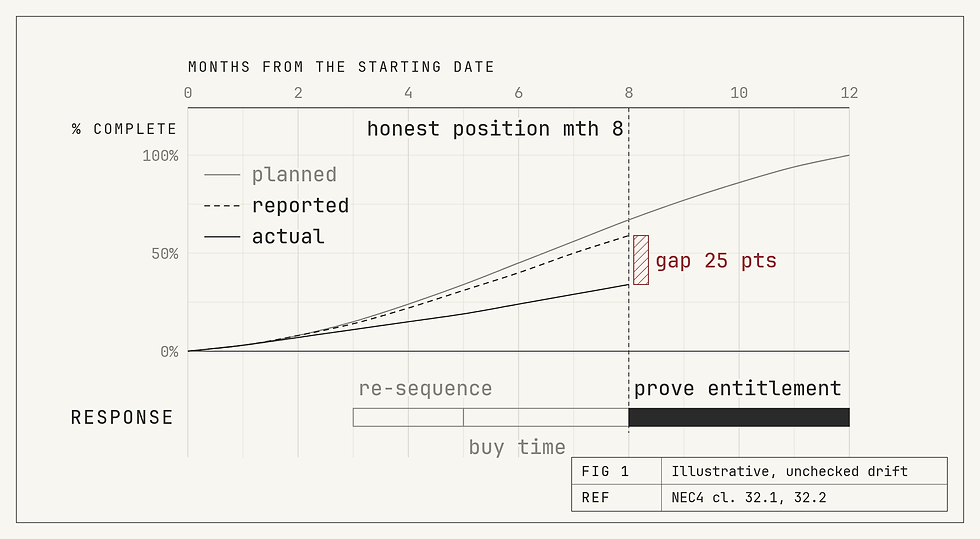
Early, while the gap is still measured in weeks, recovery is mostly re-sequencing. It costs agreement and some rework of the programme, and very little money. Many projects could do this and do not, because at that stage nobody is alarmed enough to commission it.
Later, the gap is beyond what sequence alone can absorb and you are buying time: additional resource, extended hours, out-of-sequence working, preliminaries running longer than priced. Now it costs real money, and under NEC the question of who pays for it becomes contentious in a way it was not three months earlier.
Later still, the date has gone and the exercise is no longer recovery, it is a demonstration of entitlement. That is a different discipline with a different cost base, and it depends on records that were mostly created or lost during the period nobody was acting, which is exactly why the structure of a time impact assessment matters most to the projects least likely to have kept what it needs.
The view from the desk
The projects that recover are not the ones with the most resource. They are the ones where somebody said the position was worse than reported while there was still time for that to be useful. I have never seen a recovery fail because the analysis was too slow. I have seen plenty fail because the first honest conversation happened two quarters after the first honest conversation was possible.
My position is that recovery should be commissioned on the evidence of drift rather than on the arrival of a crisis. The trigger should be structural, not emotional: a critical path that has not changed in three months, a completion date holding while progress slips, compensation events that stopped appearing in the programme. Any one of those justifies the exercise, and all three are visible long before anybody panics.
And it should be done by somebody with no stake in the previous reporting. Not because the team is dishonest, but because nobody marks their own homework well under pressure, and the whole value of the exercise is in the part that is difficult to write down.
Summary
Programme recovery means establishing the true position, rebuilding a programme that describes it, and only then deciding what to do about the end date. Compressing bars to fit a date is not recovery and does not survive a fortnight of contact with site.
The crossover from effort to futility happens quietly and is visible in the programme before it is visible in the reporting. The options narrow from re-sequencing, which is nearly free, to buying time, which is expensive, to proving entitlement, which depends on records nobody kept. Every month of delay moves you one stage along.
Download the case for acting
Two pages built to be put in front of a director: the dated triggers that justify the exercise, what it involves, what each month of delay removes, what the output should be, and why it should not be run by the team whose reporting is in question. It downloads directly, with no sign-up.

FAQ
What is programme recovery?
The exercise of establishing where a project genuinely is, rebuilding a programme that describes that position honestly, and then determining what can still be done about the completion date. It is distinct from acceleration, which is a contractual question about paying to work faster, and from a reporting change, which closes the gap on the dashboard rather than on site.
How is programme recovery different from acceleration?
Acceleration buys time with money against a programme you still believe. Recovery is what you do when the programme no longer describes the job. Accelerating against an inaccurate programme compresses the wrong activities at cost, and the completion date moves anyway. Recovery comes first, then the question of whether acceleration is worth funding.
When should a recovery exercise be started?
On the evidence of drift rather than the arrival of a crisis. A critical path that has not changed in three months, a completion date holding while progress slips, or compensation events that have stopped appearing in the programme each justify the exercise. All three are visible well before anyone becomes alarmed, and the options available reduce with every month of delay.
Why do recovery plans usually fail?
Because they start from the required date and compress the programme until it fits, distributing the compression across activities with apparent slack rather than those driving completion. The result is a programme nobody believes and nobody plans against. They also commonly fail because they are run by the people who produced the position being examined, and because they stop at the document without changing the reporting that caused the drift.
Does a recovery programme satisfy the NEC revised programme obligation?
Only if it is submitted as one. The obligation to submit revised programmes at the interval stated in the Contract Data, or when the Project Manager instructs one, runs regardless of any recovery exercise. A recovery programme kept internally has no contractual standing. Submitted properly and accepted, it becomes the document the assessment of later events is measured against.
About the author
Roman Bazelchuk is the Founder of NEC Planning Solutions Ltd, a UK project planning and controls consultancy supporting contractors with NEC programme compliance, compensation event assessments and live project controls. He is an NEC Accredited Project Manager and holds the APMG Project Planning and Control qualification, with a BEng in Mechanical Engineering.
NEC Planning Solutions provides contract-aware planning support through a QA-governed delivery model, helping project teams keep programmes accepted, current and commercially useful from tender through to live delivery.
Programme drifting and the reporting no longer matching site?
We rebuild the programme from the records so it describes the job as it now is, and set out what each option does to the completion date, independently of whoever produced the position. That independence is what makes it useful.


