
Premier Modular v Maidstone: the NEC Accepted Programme lesson behind a £1.65m ruling
Updated: Sep 9
By Roman Bazelchuk | NEC Accredited Project Manager | APMG Project Planning and Control
Founder, NEC Planning Solutions Ltd
A June 2026 High Court ruling refused to enforce a £1.65m NEC adjudication award because the adjudicator decided the case on a programme that neither side said was the Accepted Programme. The legal headline is natural justice. The lesson for contractors is older and plainer. In NEC, a compensation event is only as good as the Accepted Programme it stands on.
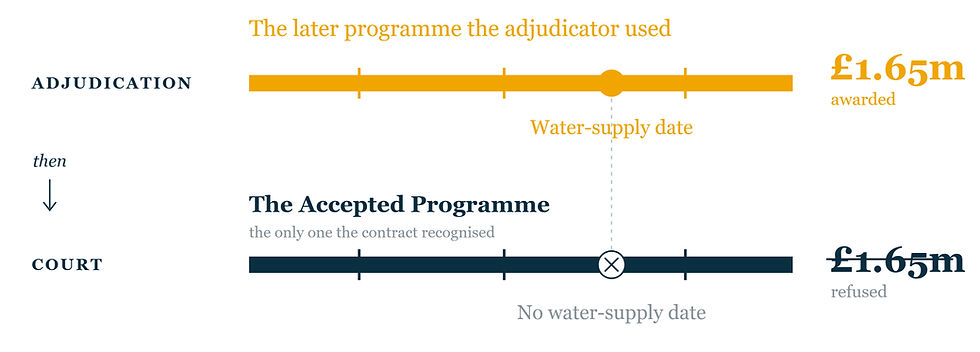
On 19 June 2026 the Technology and Construction Court refused to enforce an adjudicator's award of £1,655,385.49 in Premier Modular Ltd v Maidstone and Tunbridge Wells NHS Trust. The contract was an amended NEC4 ECC, Main Option A, for a new modular theatre block at Maidstone Hospital, tendered at close to £19.8m. The contractor said the Trust's late provision of a permanent mains water supply, needed for testing and commissioning, was a compensation event. An adjudicator agreed and put it at £1.65m. The court would not enforce that decision.
Most of the commentary will sit on natural justice, and fairly so. The judge found the adjudicator had gone off on a "frolic of his own", deciding the dispute on a basis neither party had argued and that the Trust had no real chance to meet. The law firms will cover that ground well. What follows is the other reading, the one a planner sees first. The £1.65m did not fall apart in court. It fell apart on the project, in how the programme was accepted and in what the accepted baseline did and did not contain.
What the case actually turned on
The parties agreed on one thing, and it decided everything. The only Accepted Programme under the contract was the original, the one attached to it at the outset, and that programme set no date by which the permanent water supply had to be provided. No later programme had ever been accepted by the project manager. So at the moment the contractor needed to show the Trust had missed a required date, the accepted baseline held no such date to miss.
The adjudicator closed that gap himself. He found that a later, contractor-issued programme had effectively become the Accepted Programme, then used it to conclude that the Trust had been late with the water, which is where the compensation event and the money came from. The trouble was that no one had run that argument. Both sides had agreed the Accepted Programme was the original. Deciding the case on a different one, without ever putting it to them, was the unfairness that cost the award its enforceability.
A point of fairness cuts the other way too. The court did not find that the contractor was wrong about the delay, or that nothing was due. It found that the path to the answer was unfair. The underlying claim is still open and can be brought again, properly. The contractor may well have been delayed, and may well be owed. What it did not have was the one document that could have proved it.
Why the NEC Accepted Programme was the whole case
Take the natural justice point away and a project controls failure is left standing in the open. A compensation event for a client-caused delay is, at bottom, a claim that the client missed a date the contractor was entitled to rely on. In NEC, the date you are entitled to rely on is the one in the Accepted Programme. If the dependency, here a water supply the client had to provide, never appears in an accepted programme, there is no accepted date for the client to have missed, and the entitlement has nothing underneath it.
This is the same trap worth seeing in full, what happens to a compensation event when there is no accepted programme. The case is only the most expensive recent version of it. By the time of the dispute the water supply was the entire argument, and it sat nowhere in the one programme the contract recognised.
Acceptance is a status you earn, not one you assume
Under NEC4 ECC a programme does not become the Accepted Programme by being issued, by being the newest version, or by being the one the site is actually working to. It becomes the Accepted Programme when the project manager accepts it, or when acceptance follows because the project manager let the period for reply pass and the contractor notified that failure. Clause 31 governs the first programme and its acceptance, Clause 32 the revisions. Getting a programme built and accepted under those clauses is a discipline of its own, and it is precisely the discipline that was missing here.
Let later programmes pile up without ever taking them through acceptance, and the baseline the contract recognises stays frozen at the original, however stale it has become. Every entitlement resting on a date added since then, a moved access date, a fresh client dependency, a resequenced milestone, becomes unprovable, because the accepted baseline does not carry it. The water supply shows the point exactly. It was the heart of the dispute and absent from the only programme that counted.
The notice point in the background
There was a second defence worth flagging. The Trust argued that even if a compensation event existed under the grounds relied on, the contractor had not notified it inside the time the contract demands, the condition precedent at Clause 61.3. The court did not have to resolve it, but it is a useful reminder that NEC entitlement runs on two disciplines at once. The programme has to carry the cause and effect. The notice has to land in time. A contractor strong on one and loose on the other is exposed, and a great deal of real entitlement is lost every year on the notification clock alone.
What this means for contractors
None of the lessons here are legal. Take every programme through acceptance, or force the point by notifying the project manager's failure to respond, so the baseline you lean on is one the contract recognises. Get the dates and dependencies owed by the client and others, the very things most likely to trigger a compensation event, into that accepted baseline rather than into a working file on someone's laptop. Notify compensation events inside the window. And do not walk into an adjudication leaning on a programme that was never accepted. The moment your entitlement depends on a baseline the other side never agreed and the contract never recognised, you are asking the tribunal to make your case for you. As this ruling shows, a tribunal that does so can hand you a number that will not survive enforcement.
And for project managers and clients
The discipline runs both ways, which is why it should hold the client's attention as much as the contractor's. A project manager who lets acceptance drift, who neither accepts a revised programme nor gives reasons within the period for reply, manufactures the exact ambiguity this case turned on. Accepting on time, or refusing on time and saying why, protects the client every bit as much as the contractor, because it keeps the baseline definite and keeps any later fight anchored to something both sides once signed. A current Accepted Programme is risk management for whoever is paying. It is not a favour to the other side.
How NEC Planning Solutions helps
NEC Planning Solutions Ltd is a UK-registered project controls consultancy, director-led, with senior NEC-accredited review on every output. The firm keeps the Accepted Programme where it belongs, current and recognised: Clause 31 and 32 submission and acceptance, compensation event assessment and quotation, forensic delay analysis, and independent programme assurance for contractors and project managers alike. It is the same work that, done in time, keeps a £1.65m entitlement on its feet instead of leaving it for an adjudicator to rescue.
Download the NEC4 Programme Acceptance Checklist
The pre-submission gate that keeps a programme acceptable under Clause 31 and 32, so the baseline your compensation events rely on is one the contract recognises. Free, direct download, no sign-up.
Need a programme the Project Manager can accept first time?
If submissions are coming back with reasons attached, or the accepted programme has fallen behind the job, NEC Planning Solutions puts the clause 31.2 content in place and keeps the revision cycle running to the contract.
About the author
Roman Bazelchuk is the Founder of NEC Planning Solutions Ltd, a UK project planning and controls consultancy supporting contractors with NEC programme compliance, compensation event assessments and live project controls. He is an NEC Accredited Project Manager and holds the APMG Project Planning and Control qualification, with a BEng in Mechanical Engineering and postgraduate training in Planning and Control.
NEC Planning Solutions provides contract-aware planning support through a QA-governed delivery model, helping project teams keep programmes accepted, current and commercially useful from tender through to live delivery.


